Kinesitherapy means treatment that takes advantage of different forms of movement. The main objective of this therapy is to restore painless movements of spine and limbs, body efficiency improvement, muscle resistance enhancement and controlled weight drop. Kinesitherapy also includes forming correct movement habits.
APPLICATION 
Kinesitherapy is used in prevention, recreation and rehabilitation. Therapeutically, we use adequately chosen exercises in w:
We offer in our Klinik:
1. Individual active exercises – Exercises are performed single-handed by patient under the supervision of physiotherapist who determines the kind of exercises individually for every single patient in accordance with the doctor and patient’s indication. Therapist can have a few patients under his care and use apparatus and rehabilitation tools that are in the Individual Exercises Room.
2. Individual exercises after manual therapy – exercises are performed individually by patient and under the physiotherapist’s supervision, who acts according to recommendations received from manual therapist after having the patient examined. Therapist can have a few patients under his care and use apparatus and rehabilitation tools that are in the Individual Exercises Room.
3. Passive and active-passive exercises conducted by therapist – treatment using some movements that therapist performs on patient in the case of patient’s limited fitness (e.g. paralysis) or in the case of manual extension of different tissues (e.g. muscle contractures)
4. Exercises on apparatus – weight training under the care of physiotherapist with the use of OLIPMP company equipment with the aim of strengthening appropriate muscle groups working in the most favourable body arrangement
5. Kettler – efficiency training performed on stationary bicycle with the possibility of choosing different programmes that dose load. In the case of circulatory insufficiency, it is possible to carry out the training controlled by pulse
6. Team exercises – exercises conducted by physiotherapist for the group of patients performing the same exercise at the same time in the Team Exercises Room. Depending on the kind of disease, we offer circular-respiratory gymnastics, overall fitness and relaxation gymnastics as well as gymnastics for people with backbone illnesses
7. Team exercises in water – exercises conducted by physiotherapist for the group of patients performing the same exercise at the same time in the pool. Aqua environment relieves man’s joints and provides optimal conditions for muscle training in the case of joint diseases of lower limbs and backbone.
8. Individual exercises in water – exercises conducted by physiotherapist in the pool for one patient with limited fitness. Therapist can make the patient perform movements unaided or help him perform those movements.
9. Exercises in water – aqua aerobics – intensive exercises with music conducted in the pool by instructor for the group performing the same exercise at the same time. Exercises are performed with the use of special tools that increase water resistance.
10. Nordic Walking – efficiency training that relies on fast march and using sticks for pushing the body back from the surface by means of the shoulder work. Active work of shoulders decreases the load of backbone and joints of lower limbs. Moreover, this work increases body energy expenditure and helps lose overweight much faster.
11. Auto therapy – it is the system of therapy and prevention of pain syndrome in motor system. It relies on the precise and individual choice of muscle loosening or strengthening exercises and patients’ education which will help them perform exercises back at their homes. Precise and systematic exercises included in the programme of auto therapy prevent recurrence
12. Biomechanical diagnostics – examination of bone movement, joint elasticity, strength and length of muscles and nerve movement in order to determine the source of pain that occurs during body movements (e.g. walking, getting up) or during remaining in a given posture (e.g. bending, sitting etc.).
13. Manual therapy – it is the manual restoration of appropriate mobility for blocked vertebras, joints and nerves. Therapist also skillfully extends the contracted muscles, and, in the case of damaged disc, he improves the mobility of neighbouring tissues manually in order to speed up disc healing. Therapist recommends performance of appropriate exercises and gives hints for correct body posture during day and night in order to sustain progress. Manual treatment for patients with severe osteoporosis, acute joint inflammation or significant degenerative joint changes is conducted with the doctor’s consent but in a delicate manner.
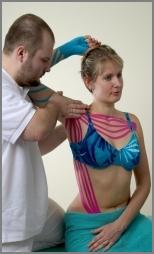
14. Kinesiotaping – it is so called plaster sticking. Therapist sticks a few elastic plasters on the patient’s body. They improve or relieve muscle work, increase punctual blood circulation or protect torn and overloaded ligaments.
15. Reflexology – pricking ligaments and insertion of muscles with dry needle in order to get rid of pain that radiates from those structures.